Surfboard Fin Evolution: The Complete History & Guide
Surfboard fin history matters to B2B buyers because each design change created a different product need. Single fins, twin fins, thrusters, quads and removable systems changed not only how boards performed but also how brands specify templates, fin-box compatibility, materials and replacement ranges. For surfboard manufacturers, shapers, shops and distributors, understanding that evolution helps separate a useful product story from a manufacturing specification. This guide follows the major milestones from finless boards to modern fiberglass and removable-fin programs, then connects them to today’s OEM decisions. Use it to decide which fin setup fits your product line, what compatibility information a supplier needs and where a custom template can add value without creating unnecessary tooling or fitment risk.
Before Fins: The Age of Finless Surfboards
To understand why fins matter, we first need to go back to ancient Hawaii.
Hundreds of years ago, Hawaiian surfers rode wooden boards called Olo and Alaia boards. These boards were carved from solid wood. They were beautiful, heavy, and completely finless.
At that time, surfers did not have a steering system under the board. As a result, most rides went straight toward the beach. Turning was possible, but it was difficult.
When surfers needed more control, they often used their feet. They dragged one foot in the water to slow down or change direction. This created drag, but it was not smooth or efficient.
In simple terms, early surfing was like riding a bicycle without brakes. The rider could still move, but control was limited.
Because of this, wave riding stayed close to its original form for a long time. Surfers had skill and courage, but the board itself had not yet become a high-performance tool.
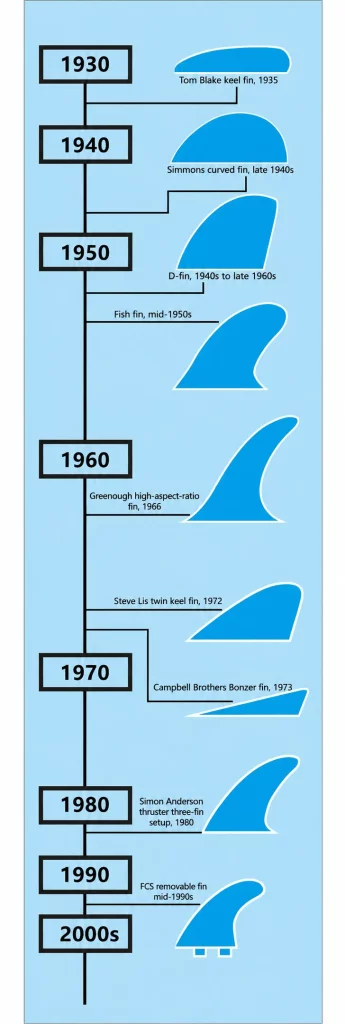
1935: The First Practical Surfboard Fin
A major change came in 1935.
Tom Blake, a well-known surfer and inventor, wanted more control over his board. At the time, surfboards were still heavy and hard to turn. Blake noticed that boats used rudders to move through water with better direction.
So, he tried a simple idea.
He attached a small rudder-like fin to the bottom tail of his surfboard. This became one of the first practical surfboard fins.
The result was powerful. The board no longer slid as easily. It held better in the wave. More importantly, the surfer could lean into a turn and feel the board respond.
This single change transformed surfing.
Instead of only riding straight, surfers could begin to control their direction. They could stay on the open face of the wave for longer. They could also turn with more confidence.
Although the first fin was simple, it opened the door to every fin design that followed.
The 1940s: Science Enters Surfboard Design
After Tom Blake proved that fins worked, surfboard builders began to ask better questions.
What shape should a fin have?
How deep should it be?
How could it reduce drag while improving control?
During the 1940s, Bob Simmons helped bring science into surfboard design. He studied mathematics, aerodynamics, and how water moves around objects. This field is called hydrodynamics.
Earlier fins were often thick and blocky. They gave control, but they also created drag. Too much drag slowed the board down.
To solve this, builders started shaping fins with smoother curves. These designs allowed water to flow more cleanly around the fin. As a result, boards became faster and easier to control.
This was an important step. Surfboard fins were no longer just simple steering pieces. They became performance parts.
From this point forward, fin design began to combine surfing experience with science.
The 1950s and 1960s: From Stability to Performance
By the 1950s, the single fin had become the standard setup.
Most longboards used one large fin near the tail. These fins were often deep and wide. Their main job was to give stability.
This setup worked well for classic longboard surfing. Riders could walk toward the nose, trim along the wave, and perform stylish moves like hanging ten.
However, surfing kept changing.
As surfers wanted sharper turns and faster reactions, large single fins began to feel limiting. They were stable, but they were not always loose or responsive.
In the 1960s, shapers started looking at nature for better ideas. Dolphins, fish, and other sea animals showed how curved shapes could move through water with less resistance.
At the same time, materials improved. Builders moved away from heavy wood and began using fiberglass and resin. This was a major upgrade.
Fiberglass made fins stronger, thinner, and more precise. It also allowed cleaner edges and better flex. Because of this, surfers could push harder through turns without losing control.
One important influence came from George Greenough. He studied the movement of tuna fish and designed fins with a narrower base and a more flexible tip. These fins helped surfers make tighter turns and ride with more speed.
By the late 1960s, fin design was no longer just about stability. It was about performance.
The 1970s: The Rise of Twin Fins and Experiments
The 1970s became one of the most creative periods in surfboard fin history.
Surfers and shapers began to question the single-fin standard. Instead of asking how to improve one fin, they asked a new question:
What happens if we add more fins?
This led to many experiments.
One of the most important designs was the twin fin. Instead of using one center fin, the board used two side fins. This setup created a fast and loose feeling.
Twin fins worked especially well on wide fish-style boards. They generated speed quickly and felt playful in smaller waves. Surfers could draw fast lines, make quick turns, and ride weaker waves with more energy.
Around the same time, other systems also appeared. The Bonzer, designed by the Campbell brothers, used a center fin with smaller side fins and special bottom contours. This design helped channel water through the board for speed and grip.
Later in the decade, Mark Richards brought twin fins into competitive surfing. His fast and flowing style proved that twin fins could perform at the highest level.
As a result, surfers began to see fins as a tuning system. Different setups created different feelings underfoot.
That idea still shapes surfboard design today.
The 1980s: The Thruster Changes Everything
Twin fins were fast, but they had one clear weakness.
In larger or more powerful waves, they could feel loose. Without a center fin, the tail could slide during hard turns. For some surfers, this made the board exciting. For others, it made the board harder to trust.
In 1980, Australian surfer and shaper Simon Anderson introduced a solution. He created the thruster setup.
The thruster used three fins: two side fins and one center fin.
This design balanced speed, control, and turning power. The side fins gave drive and response. Meanwhile, the center fin added hold and stability.
The result was a setup that worked in many wave conditions. Surfers could turn hard without losing control. They could also generate speed and attack steeper parts of the wave.
By the mid-1980s, the thruster became the most popular setup for shortboards. Even today, it remains one of the most widely used fin systems in the world.
The reason is simple. It works.
Removable Fin Systems: More Choice for Surfers
For many years, fins were glassed directly onto the surfboard. This created a strong connection, but it also had problems.
If a fin broke, repairing it was difficult. Traveling with fixed fins was also inconvenient. The fins could be damaged in board bags, cars, or airports.
Removable fin systems changed that.
With fin boxes, surfers could take fins on and off. They could also change fin size, shape, material, and setup based on the wave conditions.
This gave surfers more freedom.
For small waves, they might choose a twin fin or a more flexible fin. For bigger waves, they might use a thruster or a larger fin with more hold. For longboards, they could adjust the single fin position to change how the board turns.
This made fins more than a fixed part of the board. They became a tool for customization.
Today, removable fins are common across many surfboard types. They are used on shortboards, longboards, fish boards, softboards, and many other designs.
Current Trends: Old Ideas Meet Modern Design
Modern surfboard fin technology is more advanced than ever. Surfers can choose from many shapes, materials, and setups.
At the same time, some riders are exploring older ideas again.
Finless surfing is one example. Some surfers remove fins completely and rely on rail shape, board contours, and body control. This style is difficult, but it offers a loose and free feeling.
In another direction, traditional keel fins and classic single fins are also making a comeback. Many surfers enjoy their smooth lines, speed, and retro style.
This shows an important point.
Surfboard fin evolution is not a straight line. It is a cycle of testing, learning, and returning to useful ideas with better materials and better production methods.
What worked in the past can still inspire new designs today.
Why Surfboard Fin Design Still Matters
A surfboard fin may look simple, but small changes can make a big difference.
The outline affects turning style.
The base affects drive.
The depth affects hold.
The flex affects response.
The material affects strength and feel.
Because of this, fins are not just accessories. They are part of the surfboard’s performance system.
For a surf brand, the right fin can improve the riding experience. For a surfboard manufacturer, consistent fin quality helps protect the final board quality. For surf shops and distributors, good fin options can also create more value for customers.
This is why custom fin production is still important.
Different markets want different styles. Some customers prefer classic longboard fins. Others need twin fins, keel fins, thruster sets, quad sets, or custom templates for their own board models.
As surfing continues to grow, demand for better and more personalized fins will continue as well.
Custom Fiberglass Surfboard Fins for Modern Brands
At Daywin Watersports, we are proud to support the ongoing evolution of surfboard fins.
From early wooden boards to modern removable fin systems, fins have always helped surfers control speed, stability, and turning performance. Today, brands and manufacturers need fins that are not only functional but also consistent, attractive, and suitable for their own product lines.
As an OEM manufacturer, we focus on custom fiberglass surfboard fins for surf brands, surfboard manufacturers, surf shops, and distributors.
We can produce fins based on customer drawings, reference photos, templates, or existing samples. Depending on your project, we can support custom outlines, sizes, colors, patterns, and logo designs.
Our fiberglass fins can be developed for many common setups, including keel fins, single fins, twin fins, thruster sets, quad sets, and longboard fins.
