How to Choose Surfboard Fins: 6 Pro Secrets for Speed
In the world of surfing, the board often gets all the glory, but the fins do all the work. If the surfboard is the body, the fins are the soul, the steering wheel, and the turbocharger all in one. Without them, even the most advanced carbon-fiber board is just a floating log at the mercy of the current.
Understanding the “science of the skeg” is the fastest way to level up your surfing. In this guide, we will break down the century-long evolution of fin design, the high-tech materials used in modern manufacturing, and the technical physics that dictate how your board moves through the water.
I. The Evolution of Control: A Historical Timeline
The history of the surfboard fin is a story of surfers constantly seeking a way to tame the energy of the wave. For centuries, surfing was a “finless” pursuit, which limited the sport to straight lines and sliding sideways.
1. The Pre-Fin Era: The Art of the Slide
Before the 1930s, surfers rode “Alaia” or “Olo” boards made of solid wood. These boards had no fins. To steer, a surfer had to use their feet to sink the rail (the edge) of the board into the wave face.
- The Slide-Slip: Without a fin to act as a pivot point, boards would frequently “slide-slip”—spinning out sideways.
- The Limitation: Because control was so difficult to maintain, high-speed carving and vertical surfing simply didn’t exist.
2. 1935: The Birth of Modern Surfing
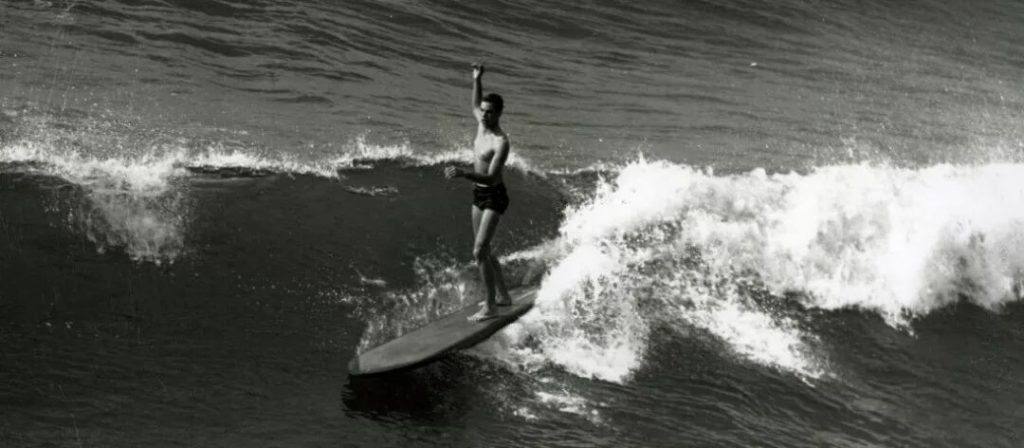
The trajectory of the sport changed forever in 1935 when surfing pioneer Tom Blake had a “eureka” moment. He took a 12-inch metal keel from a discarded speedboat and bolted it to the bottom of his surfboard.
- The Result: Immediate stability. For the first time, a surfer could hold a line in a steep wave without spinning out.
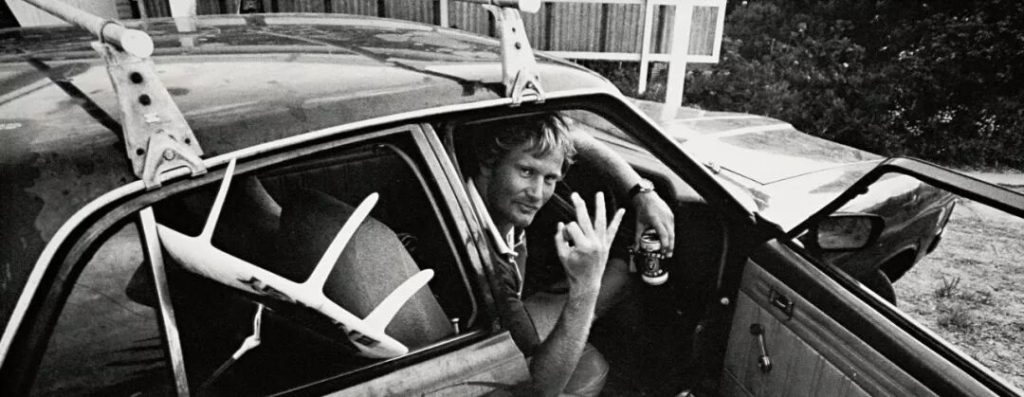
- 1940s Refinement: By 1940, Gard Chapin developed wooden keels with slanted leading edges, allowing for the first real directional turns.
3. The 1960s: The Flexible Revolution
As the “Shortboard Revolution” began, the industry looked to nature for inspiration.
- George Greenough (1961): Greenough, a visionary kneeboarder and designer, looked at the high-speed efficiency of the Bluefin Tuna. He realized that a fin should be flexible, not rigid. He designed high-aspect-ratio fins that could “load up” energy during a turn and “snap” back, propelling the surfer forward.
4. 1970–1980: The Multi-Fin Era

- Twin Fins (The 70s): Mark Richards dominated the world stage by using two fins. This setup offered incredible speed and a loose, “skatey” feel in small waves.
- The Thruster (1980): Simon Anderson introduced the three-fin “Thruster” setup. By adding a central trailing fin to the twin-fin design, he created a system that offered both the speed of a twin and the control of a single fin. This remains the professional standard today.
II. Manufacturing & Materials: The Tech Beneath the Surface
From a supply chain and manufacturing perspective, fin construction has evolved into a high-precision science. The materials chosen dictate the Flex Pattern—how the fin bends and returns to its original shape.
1. The Material Spectrum
- Injection Molded (Plastic/Nylon): These are the most common fins for beginners. They are flexible and forgiving. While they lack the “spring” of high-end fins, they are durable and significantly safer (less likely to cause injury).
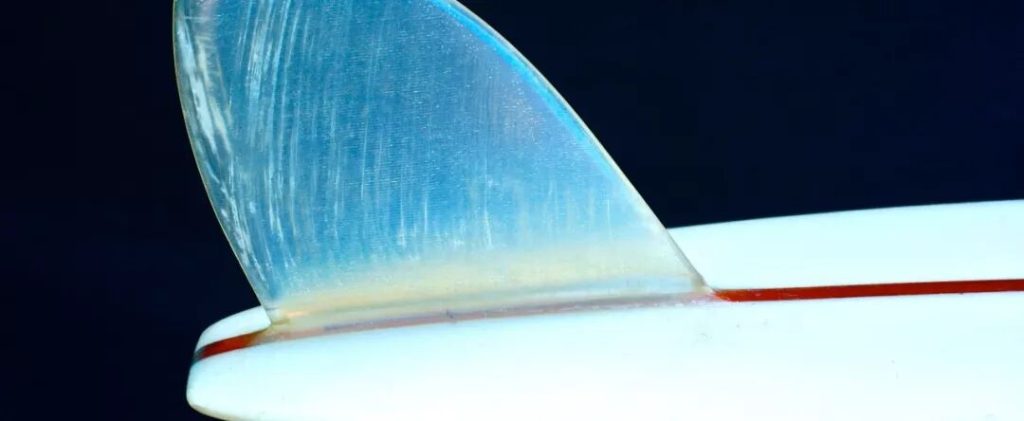
- Fiberglass (Glass-on & RTM): Solid fiberglass fins are stiff and powerful. Resin Transfer Molding (RTM) allows manufacturers to create lightweight fins with a consistent flex that mimics the classic feel of traditional glass-on fins.
- Honeycomb & Performance Core: These fins utilize a hexagonal foam core to shed weight while maintaining a stiff base. They are favored by intermediate to advanced surfers for their balanced “lively” feel.
- Carbon Fiber: The pinnacle of fin technology. Carbon fiber is used to control the flex specifically at the tip or the base. It is incredibly responsive, providing an immediate “ping” of energy when coming out of a turn.
2. Modern Fin Systems
Today, the industry is dominated by two major removable fin systems: FCS (Fin Control System) and Futures.
- Versatility: These systems allow surfers to travel easily (by removing fins) and to “tune” their board. You can use the same board but change its personality entirely by swapping from a stiff carbon fin to a flexible fiberglass one.
III. Understanding Fin Configurations
How many fins should you ride? The answer depends on the wave conditions and your personal surfing style.
| Setup | Characteristics | Best For |
| Single Fin | Stable, smooth, and rhythmic. | Longboarding and “soul” surfing. |
| Twin Fin | Fast, loose, and effortless in flat sections. | Small to medium “mushy” waves. |
| Thruster | Predictable, high-control, and versatile. | High-performance surfing in almost all conditions. |
| Quad | Maximum speed and “down-the-line” grip. | Hollow tubes or very small, weak waves. |
| 2+1 Setup | A blend of single-fin stability and thruster pivot. | Mid-lengths and performance longboards. |
IV. Technical Deep Dive: The Anatomy of a Fin
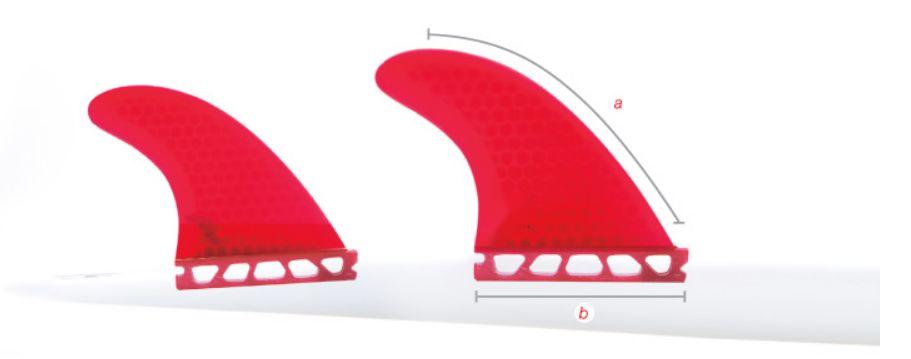
To truly understand performance, you must look at the six key elements of fin geometry:
1. Sweep (Rake)
The “Sweep” is how far the tip of the fin curves back relative to the base.
- Large Sweep: Like the wings of a fighter jet, more sweep allows for long, drawn-out carves.
- Small Sweep (Upright): An upright fin allows for a tight turning radius, making it easier to “pivot” and snap the board off the top of the wave.
2. Base
This is the widest part of the fin where it meets the board.
- Wide Base: Provides more “drive.” When you push against the wave, a wide base pushes back, generating forward momentum.
- Narrow Base: Offers less resistance, making it easier to initiate a turn.
3. Depth (Height)
This is how far the fin reaches into the water.
- Deeper Fins: Provide more “hold” and stability. Beginners and big-wave surfers prefer deeper fins to keep the board from sliding out.
- Shallow Fins: Reduce drag and allow the tail of the board to be “released” more easily for slides and tail-blows.
4. Foil
The “Foil” refers to the aerodynamic shape of the fin’s faces.
- Symmetrical Foil: Usually used for center fins; water flows evenly on both sides for stability.
- Flat Foil: Common on side fins; the flat inside face creates a consistent feel.
- Concave/Inside Foil: High-end fins use a curved inside face to create “lift” (similar to an airplane wing), which helps generate speed even in weak waves.
5. Cant (Tilt)
Cant is the angle of the side fins in relation to the bottom of the board.
- More Cant: Leads to a more responsive board during turns.
- Zero Cant (90°): Maximizes straight-line speed by reducing drag.
6. Toe-In
Side fins are rarely parallel to the stringer (the center of the board). They usually point slightly inward toward the nose. This “Toe-In” creates water pressure that makes the board feel ready to turn at a moment’s notice.
V. Sizing Guide: Matching Fin to Weight
As a standard industry practice, fin size must be matched to the surfer’s weight to ensure the correct amount of leverage.
| Size Category | Weight Range (kg) | Weight Range (lbs) | Performance Characteristics |
| Extra Small (XS) | Under 55 kg | Under 120 lbs | High sensitivity; perfect for groms and very light frames. |
| Small (S) | 55 kg – 70 kg | 120 – 155 lbs | Agile and quick; allows for rapid direction changes. |
| Medium (M) | 65 kg – 80 kg | 145 – 175 lbs | The industry standard; offers a balance of drive and pivot. |
| Large (L) | 75 kg – 95 kg | 165 – 210 lbs | Provides the necessary “hold” and leverage for powerful carves. |
| Extra Large (XL) | Over 95 kg | Over 210 lbs | Maximum surface area for maximum stability and heavy-footed power. |
Conclusion: Fine-Tuning Your Ride
The evolution of the surfboard fin from Tom Blake’s 1935 metal keel to today’s carbon-fiber thrusters has been driven by one goal: Performance.
Whether you are a beginner looking for stability or a veteran looking for that extra “pop” in your turns, your fins are the most important variable you can change. Don’t be afraid to experiment. Swapping your fins can make a five-year-old board feel brand new.
What’s in your board right now? Have you tried switching from a thruster to a quad lately? Let us know in the comments below!
