How to Scale Custom Fin Manufacturing & Slash Costs by 90%
In the fast-paced surf hardware industry, brand owners face constant pressure to innovate while protecting their profit margins. Expanding your product line to include custom fiberglass fins requires navigating complex supply chain decisions. The most critical decision is selecting the right tooling method.
Historically, factories have conditioned buyers to believe that expensive metal molds are the only viable path for mass production. However, modern supply chain data reveals a different reality.
Today, we are breaking down the true Return on Investment (ROI), production scalability, and unit economics of silicone versus metal molds. You will discover why agile silicone tooling is the ultimate scaling strategy for modern surf brands.
The Hidden CAPEX in OEM Surf Hardware
When sourcing OEM surf hardware, the primary obstacle is the initial Capital Expenditure (CAPEX). High tooling costs act as a massive barrier to entry. If a brand wants to test the market with a new fin template, expensive mold fees can instantly destroy profitability.
Procurement managers must calculate the true “trial-and-error” cost. If a new fin design fails to sell, the capital spent on the mold becomes a permanent sunk cost. Therefore, reducing this initial financial risk is vital for maintaining healthy cash flow.
The Metal Mold Trap: The Traditional Standard
For decades, metal molds have been presented as the ultimate standard for manufacturing custom surfboard fins. While they offer extreme durability, their financial implications are severe for brands looking to remain agile.
High Upfront Sunk Costs
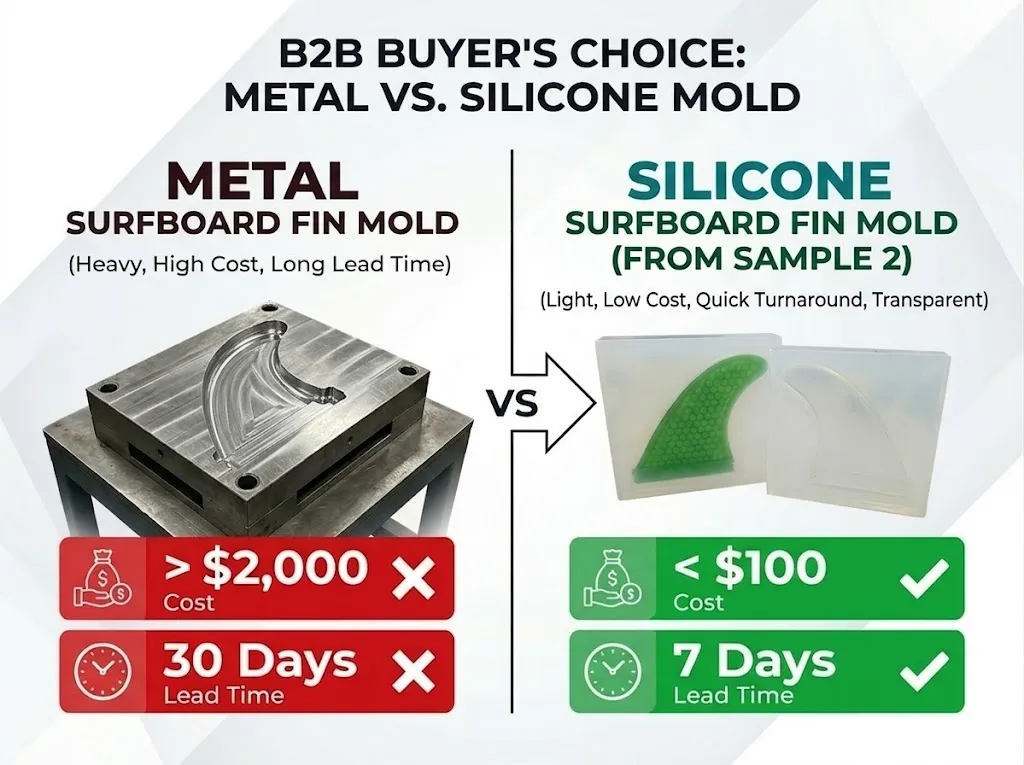
The most glaring issue with metal molds is the extreme price tag. A single metal mold for a fiberglass fin typically costs over $2,000 USD. If you plan to launch a complete setup—such as Thrusters, Quads, and Longboards—your initial tooling costs will easily exceed $10,000 before a single fin is produced.
30-Day Tooling Lead Times
Furthermore, metal molds are exceptionally slow to manufacture. Precision machining a steel or aluminum block requires a minimum 30-day lead time. In a highly seasonal retail market, losing a month to tooling delays is a massive operational risk.
The Agile Paradigm: Silicone Tooling Under $100
Advanced manufacturing facilities are shifting toward a radically different approach. Smart brands now utilize silicone as a strategic weapon to lower landed costs and accelerate product launches.
Fraction of the Cost
The financial contrast is staggering. While a metal mold costs over $2,000, a high-quality silicone mold costs less than $100 USD. By slashing tooling expenses by over 95%, your trial-and-error cost drops significantly. This empowers you to test multiple new designs without financial fear.
1-Week Rapid Prototyping
Time-to-market is everything in modern retail. With silicone tooling, a factory can create a production-ready mold in roughly one week. Consequently, brands can move from a CAD drawing to a physical, testable sample at unprecedented speeds.
Debunking the “Volume Upgrade” Myth
A common fallacy among hardware buyers is the “upgrade path.” Many assume that once an order reaches a high volume (e.g., 5,000 units), the factory must automatically upgrade to a metal mold.
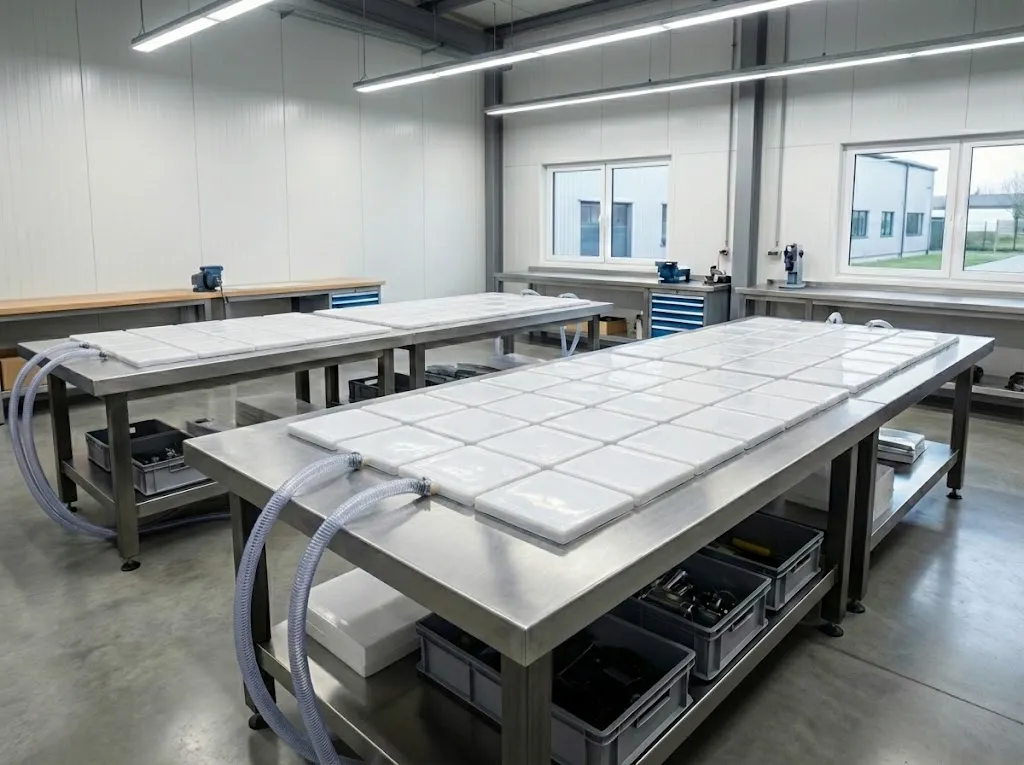
Industry best practices show this is completely false. In reality, the higher your order quantity, the more heavily we rely on silicone molds.
If a buyer orders 5,000 sets, waiting for one expensive metal mold to cycle through production is painfully slow. Instead, the factory achieves horizontal scaling. Because a silicone mold costs under $100, we simply duplicate the mold 20 or 30 times. By pouring resin into dozens of silicone molds simultaneously, production speed multiplies exponentially.
The 200-Set Lifecycle: Honest Unit Economics
A professional supply chain analysis must acknowledge the physical limitations of materials. During the Resin Transfer Molding (RTM) process, the heat and chemical reactions of the epoxy resin slowly degrade silicone.
As a result, a single silicone mold typically yields a maximum of 200 sets of fins before losing structural integrity. After 200 sets, it must be replaced.
However, the unit economics heavily favor this replacement cycle. Even if a $100 mold is replaced every 200 sets, the amortized tooling cost is merely $0.50 per set. A brand would need to produce over 4,000 sets of a single design just to break even on a $2,000 metal mold. Clearly, silicone remains the vastly superior financial choice.
Quality Assurance: Precision is Crafted, Not Molded
A major misconception is that cheap molds result in cheap products. This reflects a misunderstanding of fiberglass manufacturing. The mold material acts merely as a temporary vessel to hold the fiberglass and resin.
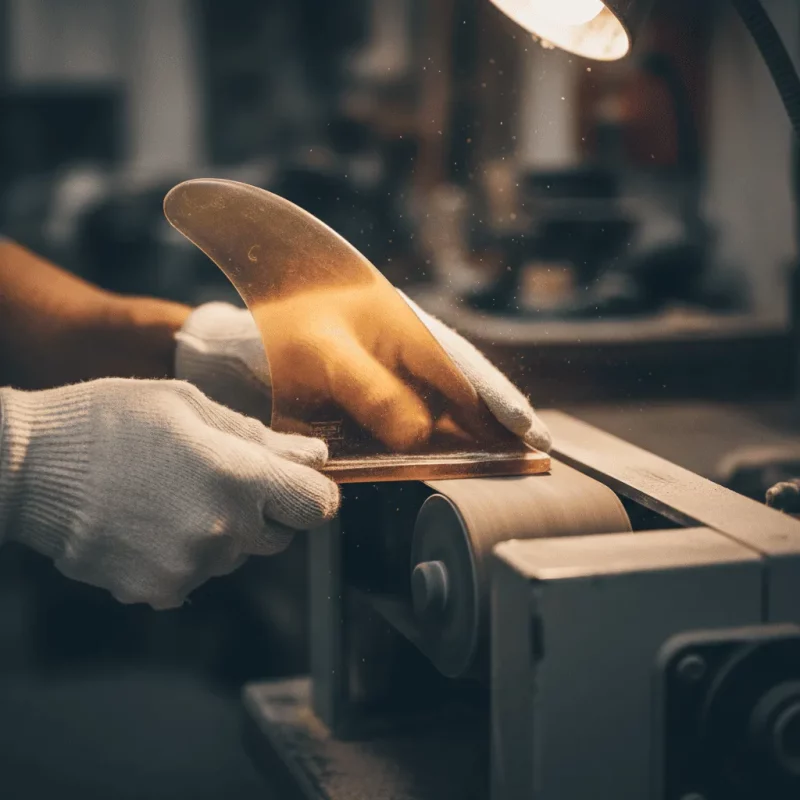
The ultimate industry truth is this: final dimensions, foil accuracy, and overall quality are determined almost entirely by post-production craftsmanship. Whether the raw fin emerges from a $2,000 steel block or a $100 silicone matrix, it is still just a rough blank.
True precision is achieved during the hand-sanding and expert polishing phases. Skilled technicians foil the edges to exact hydrodynamic specifications. Therefore, from a dimensional standpoint, there is zero difference in quality based on the mold material.
Maximize Your Profit Margins Today
Navigating the surf hardware supply chain requires a focus on scalable profit margins, not just traditional manufacturing myths.
By utilizing agile silicone tooling, brand owners can eliminate CAPEX fears and launch multiple fin templates with minimal risk. Furthermore, leveraging horizontal scaling with multiple silicone molds ensures faster delivery times than relying on singular metal tooling.
Stop letting $2,000 mold fees dictate your product roadmap. Optimize your supply chain, reduce your landed costs, and launch your next successful product line with smart manufacturing strategies.
