How to Choose the Best 2026 SUP and Surfboard Leash
Do you love riding ocean waves? Perhaps you prefer exploring calm local lakes. Either way, you must understand your equipment. First, this knowledge is the foundation of a great water session. Moreover, the leash is your most important safety tool. Therefore, we created this simple guide for you. Specifically, this complete 2026 guide will break down everything you need to know. For example, we will cover the history and core safety rules. In addition, we will explore the differences between coiled and straight designs. Ultimately, this guide will help you choose the exact leash for your next trip.
1. A Brief History of the Surf Leash
To begin with, the modern leash has a rich history. Often, people call it a leg rope. Furthermore, it has gone through many material upgrades. However, who actually invented it? Indeed, this question causes friendly debates among surfers today.
First of all, the earliest pioneer was Tom Blake. Specifically, he was a legendary waterman in the 1930s. Back then, Blake attached a 10-foot cotton rope from his board to his waist. Obviously, this was a very basic design. Additionally, it was somewhat dangerous. Still, it was the first real attempt to keep a board close.
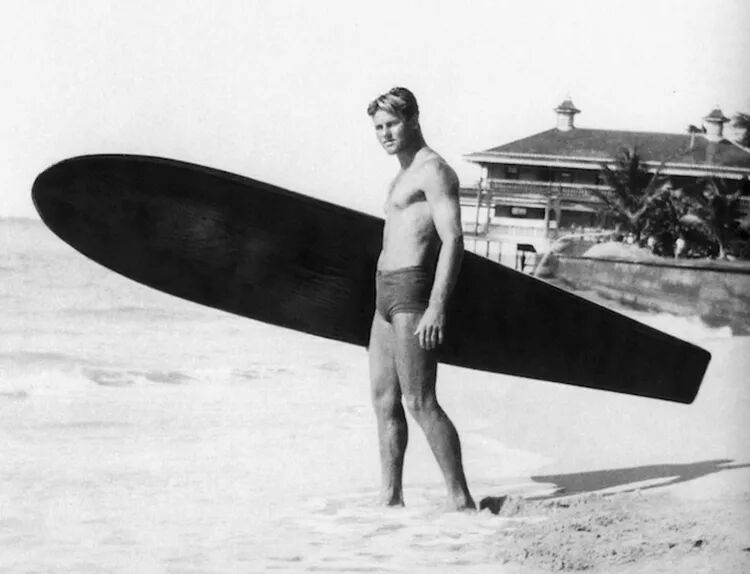
Later on, Pat O’Neill invented the modern surf leash. Specifically, this happened in the early 1970s. As a matter of fact, Pat is the son of Jack O’Neill. Importantly, Jack invented the modern wetsuit. Initially, Pat used surgical tubing. Unfortunately, this created a dangerous elastic snap-back effect. Consequently, materials evolved over the years. Today, we use high-strength urethanes. As a result, the leash is now perfect and safe for Stand-Up Paddleboarding (SUP).

2. Why Must You Wear a Leash?
Why is this tool so important? Basically, the golden rule is very simple. If you are on the water, you wear a leash. Without a doubt, it is your main lifeline. For instance, imagine falling into the water. Perhaps there are high winds or strong ocean currents. Consequently, your paddleboard acts exactly like a sail. Suddenly, a slight breeze can push your board far away.
Let’s consider the exact mechanics of a fall. First, you lose your balance and hit the water. Next, you are suddenly submerged. Meanwhile, you are still holding your paddle in one hand. Then, the wind quickly pushes your board away.
Therefore, swimming with a paddle is extremely difficult. In fact, it is exhausting. Without a leash, reaching your drifting board is a massive challenge. Sometimes, it is completely impossible. Remember, your board is a giant, unsinkable flotation device. Thus, the leash guarantees this lifesaving tool stays near you.
3. Coiled vs. Straight: Which is Better?
Now, let us look at modern leash types. Generally, they fall into two main categories. Naturally, your choice depends on your specific water conditions.
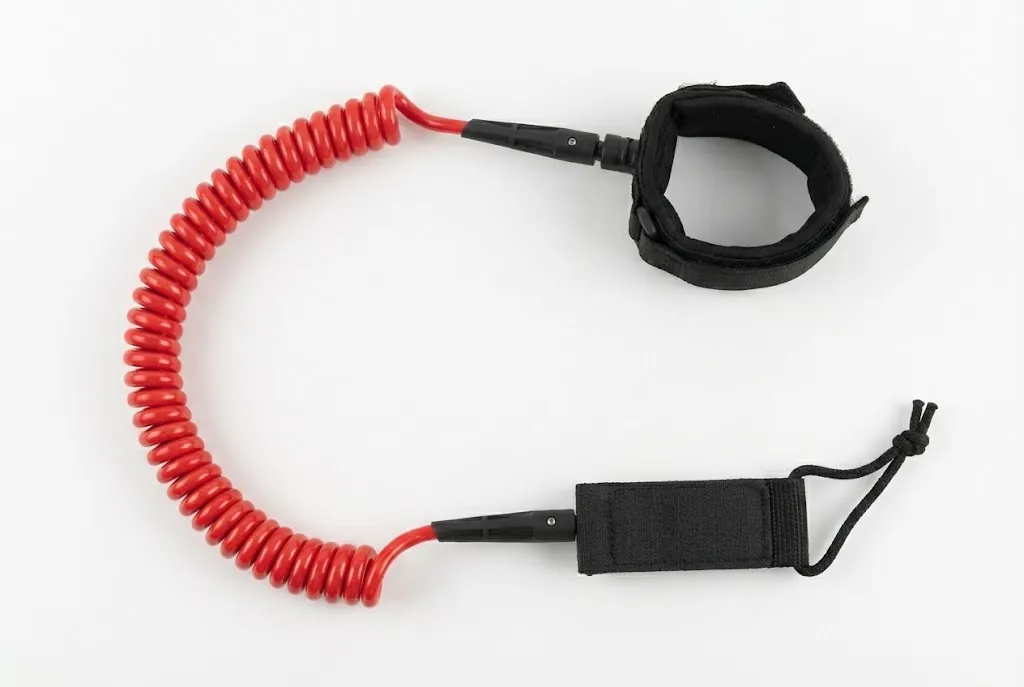
The Coiled Leash
First, we have the Coiled Leash. Visually, it looks like an old telephone cord. Typically, it is best for flatwater environments. For example, lakes, canals, and slow rivers are perfect for this.
Furthermore, the main benefit is that it rests directly on the board. Because it stays coiled, it does not drag in the water. Consequently, it will not snag on underwater debris or seaweed. In addition, it eliminates minor water drag. Admittedly, racers love this feature to save time. However, average paddlers barely notice this drag anyway. Ultimately, the real benefit is simply keeping your deck tidy.
The Straight Leash
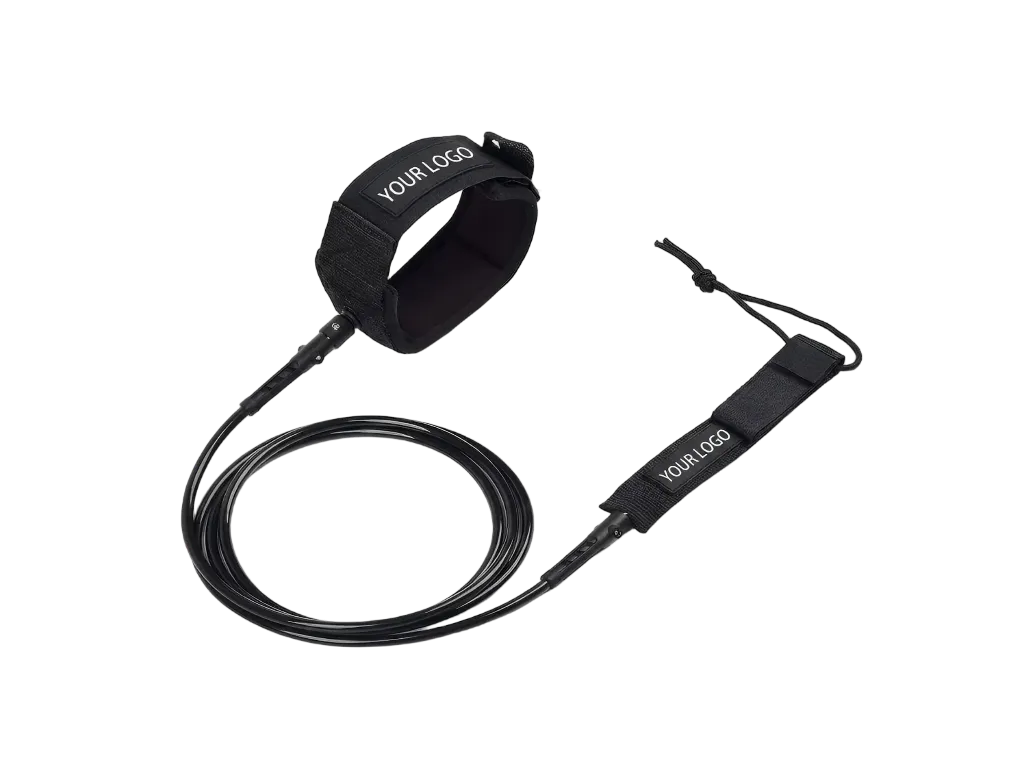
Second, we have the Straight Leash. Basically, this is a continuous, straight urethane cord. Typically, it is best for surfing and moving water.
Why is it better for waves? Because when you wipe out, the board travels safely away from you. In contrast, a coiled leash acts like a giant spring. Therefore, if you fall in waves, the coil stretches tightly. Then, it snaps the heavy board back at your head. Obviously, this is very dangerous. Instead, a straight leash stops this recoil. As a result, it keeps a safe distance between you and the board. Moreover, straight leashes are highly versatile. Indeed, you can use them on flat water too. Sure, it drags slightly, but it remains perfectly safe.
4. How to Choose the Right Length
Besides type, length is another crucial factor. Generally, your leash should match your board length. For example, a 10-foot board needs a 10-foot leash.
Why does this matter? Because a short leash will pull the board back too quickly. Conversely, a leash that is too long creates a dragging hazard. Therefore, always check your board’s dimensions first. Next, buy the corresponding leash size. Additionally, consider the wave size if you are surfing. Usually, bigger waves require slightly longer leashes. Consequently, you avoid getting hit by your own board during a severe wipeout.
5. Where to Attach It: Ankle, Calf, or Waist?
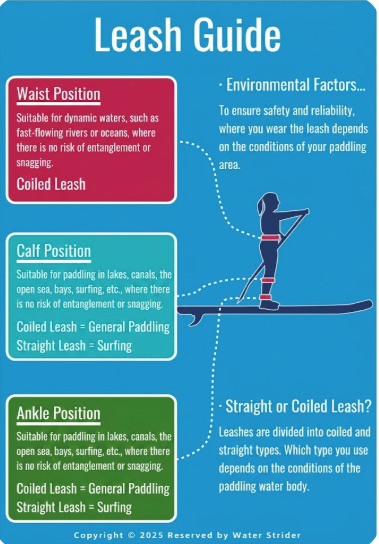
Next, you must decide where to attach the cord. Generally, there are three main attachment points on your body.
Ankle Attachment
To start, there is the Ankle Attachment. Undoubtedly, this is the most popular method worldwide. Actually, it works beautifully for both surfing and flatwater. First, the cuff wraps comfortably around your ankle. Second, it is very easy to reach. Finally, it keeps the cord low and out of your way.
Calf Attachment
Another option is the Calf Attachment. Here, you wear it just below your knee. Consequently, it keeps the cord elevated off the board. Some paddlers strongly prefer this design. Specifically, it reduces the chance of stepping on the cord. Furthermore, it is very comfortable. However, you must reach further down your leg to detach it.
Waist Attachment (Quick-Release)
Lastly, we have the Waist Attachment. Usually, this features a special quick-release belt. Importantly, this setup is strictly for fast-moving water. For instance, whitewater paddleboarding absolutely requires this belt.
Let’s explain the safety mechanism. Imagine you are in a fast river. Suddenly, your leash wraps around a rock. Immediately, the heavy water force pushes you under. Clearly, reaching your ankle is impossible here. Therefore, a waist leash provides a quick-release toggle at your chest. Consequently, one hard pull disconnects you from the board. As a result, it saves your life.
Additionally, some racers use waist leashes for beach sprints. They claim it saves precious time. Honestly, this is a stretch. After all, ripping off an ankle strap takes a split second. Therefore, using a complex belt just to save time is unnecessary.
6. Proper Leash Maintenance and Care
Moving on, let us discuss gear maintenance. Usually, high-quality leashes use Polyurethane (PU). Although it is highly durable, PU is not invincible. In fact, it suffers from wear, tear, and aging. Therefore, you must maintain it properly. Otherwise, it might snap when you need it most. Please follow these simple steps.
Firstly, always use a freshwater rinse. Specifically, saltwater and sand rapidly degrade the materials. Moreover, they jam the metal swivels. So, rinse your leash with clean water after every use.
Secondly, avoid direct sunlight. Indeed, UV rays destroy polyurethane. Therefore, do not leave your leash baking in the hot sun. Likewise, never leave it in a hot car. Instead, store it in a cool, shaded place.
Thirdly, inspect it regularly. Before you hit the water, visually check the cord. Specifically, look for micro-tears or deep scratches. Also, check the velcro to ensure it grips firmly. Additionally, ensure the metal swivels spin freely without resistance.
Finally, replace it when necessary. If you spot a crack, discard the leash immediately. Without a doubt, a damaged leash is a broken leash waiting to happen. Therefore, do not risk your personal safety to save a few dollars. Simply put, buy a brand new one.
7. The Aesthetics: Keeping it Simple
Finally, let us talk about aesthetics and style. Essentially, paddleboarding is a minimalist and graceful outdoor sport. Part of the immense appeal is the simplicity. Usually, it is just you, the board, the paddle, and the water. Naturally, taking photos is a big part of the fun.
However, it is very easy to overcomplicate things. For example, we often see paddlers wearing way too much gear. Sometimes, they paddle on calm lakes looking like tactical fishers. Specifically, they wear bulky life jackets covered in pockets. Furthermore, they trail heavy waist leashes behind them like a horse’s tail. Consequently, they look visually cluttered and messy.
Of course, safety is paramount. Yet, you must accurately match your gear to your environment. Indeed, a quick-release waist leash saves lives in dangerous whitewater. But, on a quiet local pond, it is severe overkill. Instead, a simple coiled ankle leash looks much better. As a result, it highlights the clean, natural beauty of the sport.
In conclusion, exploring nature and staying safe go hand in hand. Always be realistic about your specific paddling environment. Above all, never compromise on basic safety. However, do not ruin the sport’s simplicity with extreme gear designed for conditions you will not face. Ultimately, keep it safe, keep it smart, and always keep it simple. Ensure you have the right leash, and enjoy your time on the water!
