Avoid Costly Bodyboard Size Mistakes in Retail
Bodyboard size mistakes can make a retail program harder to manage.
For retail buyers, size affects more than product length. It affects store display, SKU control, seasonal sales, carton planning, barcode labels, and restocking.
For example, if the size range is too narrow, the store may not cover enough customers. However, if there are too many sizes, the buyer may face slow-moving stock and mixed SKUs. Also, if the PDQ display is not planned well, store staff may struggle with display and refill.
In many large-volume programs, supermarkets, beach shops, and beach chain stores choose EPS bodyboards with printed fabric surface and PP bottom. This structure keeps the board light. It also supports colorful graphics, retail-friendly pricing, and large seasonal sales.
This guide explains how retail buyers can avoid common bodyboard size mistakes. It covers 33 inch and 41 inch bodyboards, printed fabric graphics, SKU planning, PP bottom, packaging, and PDQ display plans.
Mistake 1: Choosing sizes before confirming the store channel
A bodyboard size plan should start with the store channel.
Different channels have different needs. A supermarket may need a simple summer promotion. A beach shop may want bright graphics that catch tourists’ attention. A distributor may need sizes that work for several retail customers.
Because of this, buyers should confirm the sales channel before choosing sizes.
Common retail channels include:
- Supermarkets
- Retail chains
- Beach shops
- Beach chain stores
- Tourist shops
- Seasonal product programs
- Distributors
- Private label retail programs
Each channel has a different goal.
Supermarkets often need simple SKUs, clear barcodes, and easy displays. Beach shops may care more about color, graphics, and quick impulse sales. Distributors need products that can serve several store types.
Therefore, the best size plan is not always the widest range. In many cases, a focused size range is easier to sell, refill, and manage.
Mistake 2: Ignoring 33 inch bodyboards for kids
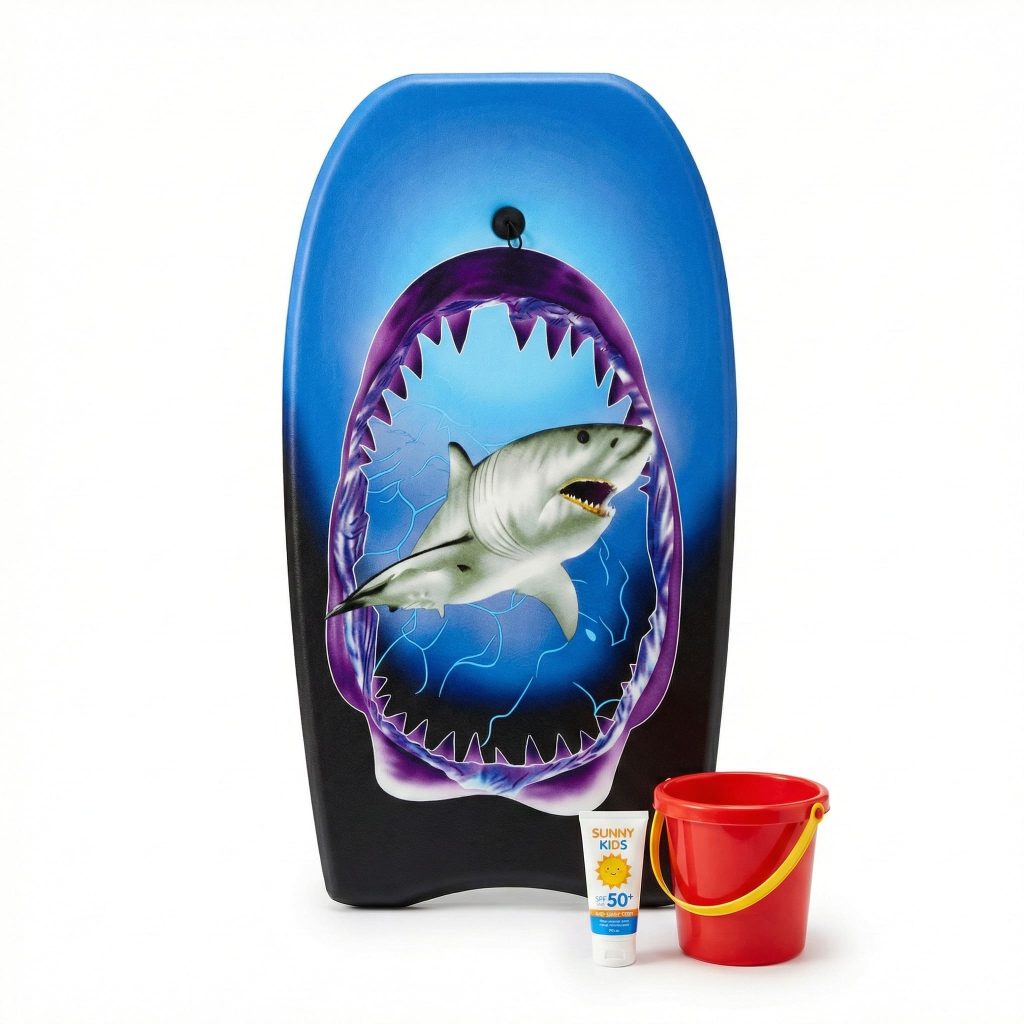
A 33 inch bodyboard is often a strong choice for kids, beginners, gift markets, and summer promotions.
This size is light and easy to carry. It also fits well in supermarket seasonal aisles, beach shops, family travel areas, and tourist stores.
For this reason, 33 inch bodyboards are often useful for large-volume retail programs.
For kids bodyboards, buyers should check:
- Light weight
- Bright printed graphics
- Easy handling
- Clear size label
- Simple packaging
- Optional leash
- PDQ display fit
- Carton quantity for store refill
In many stores, kids and parents make quick buying decisions. First, they notice the color and graphic. Then they look at the price and size.
That is why printed fabric surface matters. It allows buyers to use summer designs, cartoon-style artwork, ocean themes, animal patterns, or private label graphics.
Still, the product needs a clear structure. For large-volume retail programs, a common choice is EPS core, printed fabric surface, and PP bottom.
This type of bodyboard is not a high-end performance board. Instead, it is made for seasonal retail, family beach use, and large store programs.
Mistake 3: Choosing 41 inch bodyboards without display planning
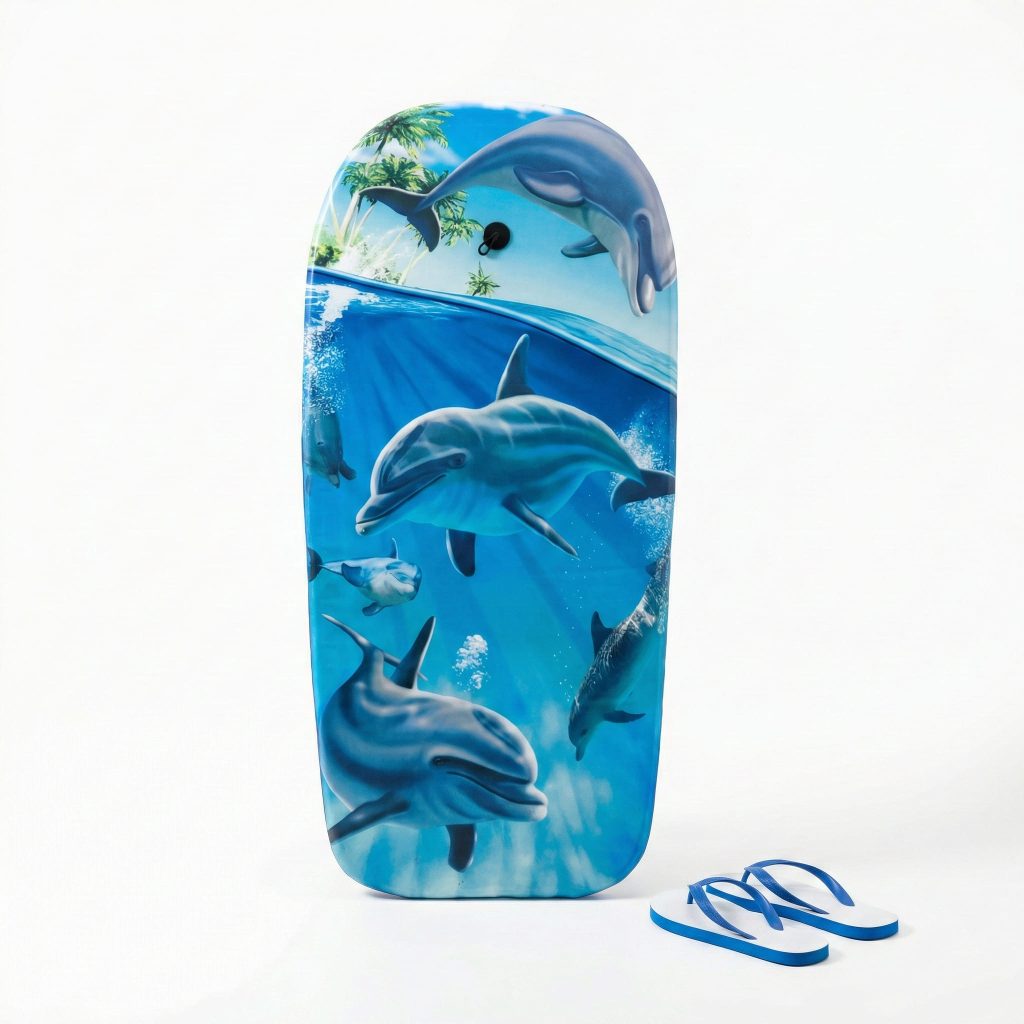
A 41 inch bodyboard is often used as a standard retail size.
It works for teenagers, adult beginners, tourist markets, and casual beach users. For beach shops, distributors, and retail chains, this size can become the main product in a bodyboard program.
However, buyers should not choose 41 inch bodyboards without checking display space.
A larger board needs more room. It also affects carton size, packing quantity, PDQ display size, and shipping cost.
Buyers may choose 41 inch bodyboards when:
- The target customers include teenagers and adults
- The store is near the beach
- The product needs stronger shelf presence
- The retail price can support a larger size
- The display area is large enough
- The carton and shipping cost are acceptable
- The buyer wants a standard bodyboard category
For large-volume retail programs, 41 inch bodyboards can also use EPS core, printed fabric surface, and PP bottom.
The goal is not advanced rider performance. Instead, the goal is a practical retail product with strong graphics, clear size value, and easy store display.
Before placing an order, buyers should check display space, carton size, corner protection, and refill method. This step helps avoid problems after the goods arrive at the store.
Mistake 4: Offering too many sizes too early
Many new buyers want to offer several sizes at once.
At first, this sounds useful. However, too many sizes can make the program harder to manage.
More sizes mean more SKUs. More SKUs also mean more barcode rules, carton marks, labels, and stock control. As a result, the buyer may spend more time managing the program than selling it.
MOQ can also become a problem. If the order quantity is split across too many sizes and graphics, each SKU may become too small.
For first orders, a simple plan is usually better.
A new buyer may start with:
- One 33 inch kids bodyboard
- One 41 inch standard bodyboard
- Two or three printed graphics per size
- One clear packaging style
- One barcode rule per SKU
This keeps the first program easier to test.
After the first season, buyers can review sales data. Then they can add more graphics, sizes, or private label options.
In short, a simple bodyboard size plan is easier for the factory, the warehouse, and the store team.
Mistake 5: Using too many printed graphics
For EPS fabric bodyboards, printed graphics are a key retail feature.
The fabric surface can carry many designs. This helps the product stand out in stores.
Common graphic directions include:
- Tropical patterns
- Summer graphics
- Ocean themes
- Wave designs
- Animal patterns
- Cartoon-style artwork
- Bright color blocks
- Kids designs
- Private label artwork
- Seasonal color series
For 33 inch kids bodyboards, brighter colors and playful artwork often work well. For 41 inch bodyboards, buyers may choose beach lifestyle designs, wave graphics, tropical themes, or cleaner brand patterns.
However, too many graphics can create SKU problems.
Each graphic may need a label, barcode, carton mark, and stock record. Because of this, retail buyers should balance visual choice with store management.
In many cases, two or three strong graphics per size are enough for a seasonal program.
A design may look attractive, but it still needs to be easy to manage. Therefore, every printed graphic plan should connect with SKU, barcode, carton mark, and PDQ display rules.
Mistake 6: Mixing different sizes in one PDQ display
PDQ display planning is important for retail bodyboards.
In most cases, one PDQ display should use one size and one SKU. This makes display, barcode control, inventory count, and restocking easier.
Mixing several sizes in one PDQ may look flexible at first. However, it often creates store problems.
Common issues include:
- Products do not sit neatly
- Sizes are harder to identify
- Barcodes become confusing
- Store staff refill the wrong items
- Small and large sizes sell at different speeds
- The display looks messy after customers browse
- Carton and PDQ matching becomes unclear
For supermarkets and retail chains, a PDQ display should make the product easy to see, easy to take, and easy to refill.
If buyers want to sell both 33 inch and 41 inch bodyboards, a better plan is to use separate displays or separate store areas.
For example:
| Product | Better Display Plan |
|---|---|
| 33 inch kids bodyboard | One PDQ for kids size |
| 41 inch standard bodyboard | One PDQ or separate display area |
| Multiple graphics | Same size, controlled graphic mix |
| Retail chain program | Clear SKU, barcode, and carton label |
This creates a cleaner retail program. It also reduces store confusion.
Mistake 7: Not confirming EPS fabric structure and PP bottom early
For large-volume retail bodyboards, buyers should confirm the product structure early.
This article focuses on EPS bodyboards with printed fabric surface and PP bottom. This structure is common for supermarkets, beach shops, beach chain stores, and seasonal retail programs.
Other bodyboard structures, such as XPE deck or HDPE slick bottom, may fit different product tiers. However, they are not the main focus of this retail-volume guide.
For EPS fabric bodyboards, buyers should confirm:
- EPS core requirement
- Printed fabric surface
- PP bottom
- Bodyboard size
- Graphic design
- Logo position
- Leash requirement
- Packaging style
- Barcode label
- SKU label
- Carton mark
- PDQ display
- Packing quantity
- Shipping destination
Clear information helps the supplier quote faster and prepare a better sample.
It also helps buyers avoid common problems. These may include unclear graphics, mixed SKUs, wrong carton marks, and display plans that do not fit the store.
Before asking for a quote, buyers should prepare the target market, store channel, size plan, quantity, graphic reference, packaging needs, and delivery schedule.
Bodyboard size planning table for retail buyers
A simple table can help buyers build a clear retail plan.
| Retail Goal | Suggested Size Plan | Notes |
|---|---|---|
| Kids seasonal promotion | 33 inch bodyboard | Good for bright graphics and family sales |
| Standard beach shop program | 41 inch bodyboard | Suitable for tourists and casual adult users |
| Simple supermarket launch | 1 core size | Easier SKU and display control |
| Larger retail chain program | 33 inch and 41 inch | Keep each size as a separate SKU |
| PDQ display program | One size per PDQ | Easier refill and barcode control |
| Private label program | Core sizes + custom graphics | Keep graphic options controlled |
The best plan depends on the buyer’s store channel.
Still, the rule is simple: start with clear sizes, clear graphics, and clear SKU control.
What packaging details should retail buyers confirm?
Packaging is not only for product protection.
For retail buyers, packaging also supports display, barcode scanning, stock control, and brand presentation.
Important details include:
- Size marking
- Printed graphic approval
- Logo position
- Barcode label
- SKU label
- Warning label if needed
- Carton mark
- Packing quantity
- PDQ display requirement
- Hang tag or shrink film
- Shipping protection
For supermarkets and retail chains, barcode and SKU labels are very important. If the store team cannot quickly identify size or graphic, stocking becomes harder.
For beach shops, packaging can be simpler. Even so, the product should still show size, design, and basic brand information clearly.
For private label buyers, packaging can also carry brand value. A clear label, color card, or printed display can make the program look more complete.
How can buyers balance size range, graphics, and MOQ?
MOQ can affect the whole bodyboard program.
If the buyer wants many sizes, colors, and graphics, the quantity for each SKU becomes smaller. This can increase production and packaging complexity.
A better approach is to control the first program.
For example, a kids seasonal program may include a 33 inch bodyboard, EPS core, printed fabric surface, PP bottom, two or three bright graphics, and one PDQ display. This plan is suitable for supermarkets, beach shops, seasonal promotions, and kids markets.
A standard beach shop program may use a 41 inch bodyboard, EPS core, printed fabric surface, PP bottom, two or three summer graphics, barcode label, and clear carton mark. This plan is suitable for beach shops, tourist shops, and distributors.
For a larger retail chain program, buyers may choose 33 inch and 41 inch bodyboards as separate SKUs. In addition, each size should have its own display plan, barcode label, and carton mark.
In each case, the buyer keeps the plan focused. As a result, MOQ, printing, packaging, and restocking become easier to manage.
What information should buyers prepare before asking for a quote?
A clear quote request saves time.
Before contacting a supplier, buyers should prepare:
- Target market
- Store channel
- Bodyboard size
- Order quantity
- EPS core requirement
- Fabric surface requirement
- PP bottom requirement
- Printed graphic reference
- Logo file
- Packaging style
- Barcode requirement
- PDQ display requirement
- Carton mark
- Shipping destination
- Target delivery date
If the buyer is not sure about the size, the store channel is a good starting point.
For example, a supermarket may need a simple 33 inch kids program. A beach shop may prefer a 41 inch standard program. A retail chain may need both sizes, but with separate SKUs and display plans.
The more clearly the buyer explains the program, the easier it is to quote, sample, and produce.
FAQ
What are common bodyboard size mistakes in retail?
Common bodyboard size mistakes include choosing too many sizes, mixing sizes in one PDQ display, using too many printed graphics, and not matching sizes with the store channel.
What bodyboard size is best for retail buyers?
Retail buyers usually choose bodyboard sizes based on target users and store channels. A 33 inch bodyboard is often suitable for kids and seasonal promotions. A 41 inch bodyboard is more suitable for standard retail programs.
Is a 33 inch bodyboard good for kids?
Yes. A 33 inch bodyboard is often used for kids, beginners, gift markets, beach shops, and supermarket seasonal displays. Bright printed graphics and light weight are important for this type of program.
When should buyers choose 41 inch bodyboards?
Buyers should consider 41 inch bodyboards when targeting teenagers, adult beginners, tourist markets, beach shops, or a standard bodyboard retail category.
Should supermarkets sell multiple bodyboard sizes?
Large supermarkets or retail chains may sell more than one size. However, each size should have a clear SKU, barcode, carton mark, and display plan. New buyers are usually better starting with one or two core sizes.
Should one PDQ display mix different bodyboard sizes?
Usually no. One PDQ display should normally use one size and one SKU. This makes display, barcode control, inventory, and restocking easier.
What materials are common for large-volume retail bodyboards?
For supermarkets, beach shops, and seasonal retail programs, EPS core, printed fabric surface, and PP bottom are common choices. This structure supports light weight, colorful graphics, retail-friendly pricing, and large-volume sales.
Why is printed fabric surface useful for retail bodyboards?
Printed fabric surface allows buyers to use colorful graphics, kids designs, tropical patterns, ocean themes, cartoon-style artwork, and private label designs. This helps bodyboards stand out in retail displays.
Why is SKU planning important for bodyboards?
SKU planning helps retailers manage size, printed graphics, barcode labels, carton marks, PDQ display, stock, and restocking. Poor SKU planning can make store operations harder.
What should buyers prepare before requesting a bodyboard quote?
Buyers should prepare bodyboard size, quantity, target market, store channel, EPS core requirement, printed fabric surface requirement, PP bottom requirement, printed graphics, logo, packaging style, barcode needs, PDQ display requirements, and shipping destination.
Planning a retail bodyboard program for supermarkets, beach shops, retail chains, beach chain stores, or distributors?
Prepare the target market, size plan, order quantity, printed graphic reference, logo file, packaging style, barcode requirement, PDQ display plan, carton mark, and shipping destination before requesting a quote.
A clear bodyboard size, material, graphic, and SKU plan helps reduce sample revisions, simplify retail display, and make bulk production easier to manage.
